01 / 09 · Gemmayzeh
Rue Gouraud workshop, 1991
Where it began and where it continues: the old pharmacy she turned into a workshop of scent.
Rooms of the house
A room is not only its walls. A room is also what comes in through the gaps.
Her life
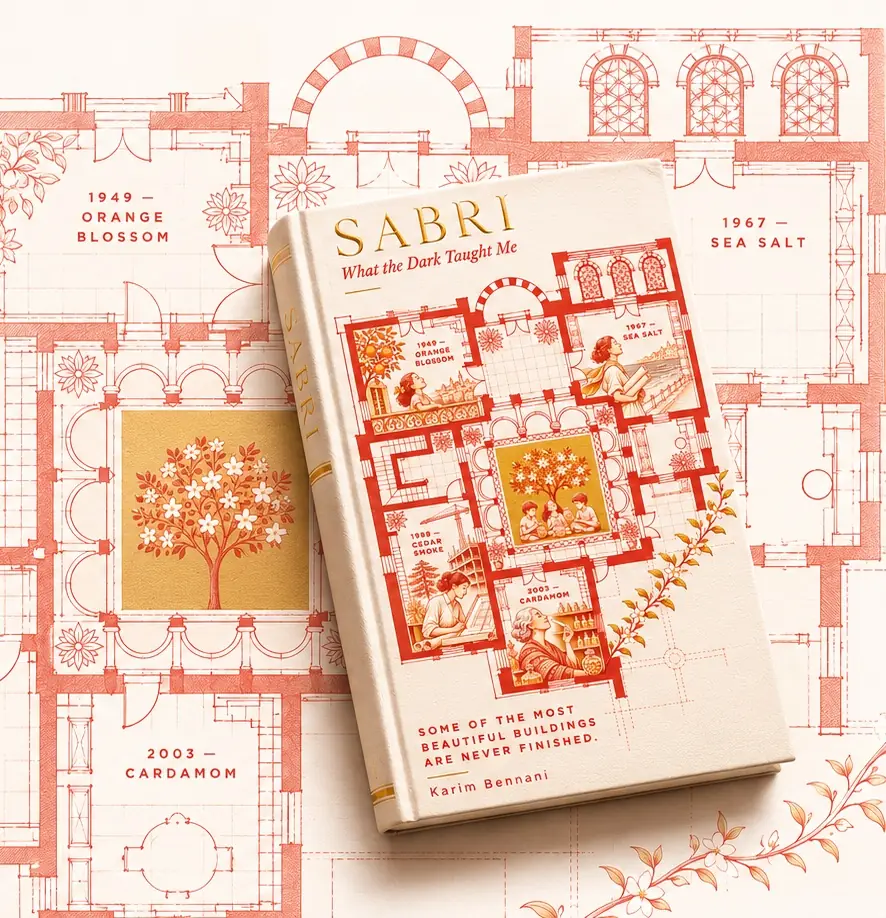
Layla Sabri was born on 14 April 1949 on Rue Gouraud, the daughter of a typesetter and a seamstress. She drew her first house at seven, in tailor’s chalk on her mother’s balcony, and her first real building at twenty-two — a four-storey house in Ras Beirut where every room sees the sea.
Between 1971 and 1988 she designed thirty-one buildings across Beirut: homes, a school, a covered arcade, the courtyard house in Clemenceau built around a bitter orange tree. Eleven of them were damaged in the war. She repaired every one she could reach.
In 1988, two-thirds of the way through the drawings for a public library in Gemmayzeh, her world changed. She spent the following year behind a closed door. Her neighbours never stopped knocking.
In 1991 she opened a workshop in a closed pharmacy two doors from the house where she was born, and began to build with scent. Her first public fragrance, Cardamom, sold out in nine days in 2003. From 2013 she travelled each month to schools for refugee children in the Bekaa Valley, teaching them to keep their homes as scent maps in small glass jars.
She still lives on Rue Gouraud. Most mornings she still walks to the sea.
In her own words
Architect of Beirut. Master perfumer. Teacher to a generation of children who lost their homes and learned to carry them.

Her Beirut
Every day at six, she walked from her house to the sea. Follow her route — her buildings light up as you pass them.
Walk it yourself — open the route in Maps01 / 09 · Gemmayzeh
Rue Gouraud workshop, 1991
Where it began and where it continues: the old pharmacy she turned into a workshop of scent.
02 / 09 · Gemmayzeh
The Gouraud library drawings, 1988
The site of her unfinished library — still an empty lot behind a green door.
03 / 09 · Saifi
Saifi stairs house, 1979
Three families, one staircase that turns the wind into a breeze.
04 / 09 · Downtown
Bab Idriss arcade, 1983
A shaded passage she designed so that the market could keep trading through the summer.
05 / 09 · Zokak el-Blat
Zokak el-Blat school, 1986
Low windows on the children’s floor, so a six-year-old can see out.
06 / 09 · Clemenceau
Clemenceau courtyard, 1981
Built around a bitter orange tree that is older than the building.
07 / 09 · Hamra
Hamra corner house, 1976
Finished during the war; she visited the site every morning at six.
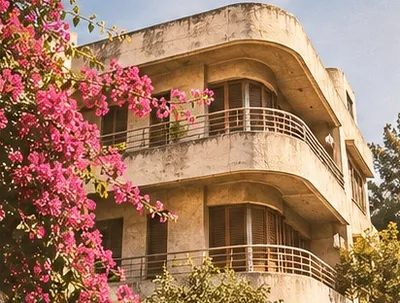
08 / 09 · Ras Beirut
Villa Haddad, 1974
A schoolteacher asked for every room to see the sea. Every room does. Still standing.
09 / 09 · Corniche
The sea wall, 1967
Where the walk ends: the fisherman’s café where she drew her first building on a napkin.
What are you still building?
Every unfinished dream becomes a stone. On 20 February, the arch is projected on the courtyard wall at Unseen.
0 stones placed so far
Please don’t include anything private — stones are shown publicly and projected at the evening.
Letters from the workshop
Unpublished pages, scent notes and the date tickets open — before anyone else.
We never share your email. Unsubscribe with one click. Read our Privacy Policy at sabribook.com/privacy-policy.

Karim signs every parcel to a name, so tell us a little about you. We use this only for your order.
Accessibility options
Adjust the site to suit you. Your choices stay on this device.